
What's Shaping Our Young People?

Gen Z & Gen Alpha and the impact of Cultural Disorientation
A Progeny reflection for parents, practitioners, educators and churches.

STARTING POINT: CULTURAL DISORIENTATION
Young people do not develop in a vacuum. Every generation is shaped by culture: the stories, relationships and systems that signal what is normal, valuable, true and possible, and where to look for meaning and help.
What appears especially significant for Gen Z and Gen Alpha is the scale, speed and convergence of cultural change that’s taking place during their early years development.
Young people today are growing up with:
· fewer widely shared foundations;
· almost unlimited access to information, ideas and experiences;
· countless competing voices and sources of influence;
· lives increasingly mediated through screens;
· and rapid, continuing cultural and technological change.
This erosion of common and widely shared foundations combined with a staggering bombardment of competing information and ideas makes orientation so much more demanding for young people and increases the emotional and physiological load that they are under. This is perhaps an area where older generations, seeking to positively influence young people, need to develop greater understanding and compassion. Have we walked a mile in their shoes?
Young people still have to work out: Who am I? What makes me valuable? What is true? Who can I trust? Where do I belong? What is my life for? Increasingly, they are answering these questions amid multiple, personalised and sometimes contradictory voices.
We use the word DISORIENTATION for what has been happening in recent generations. When the maps, anchors, trusted guides and boundaries that help a person make sense of life become less shared, more numerous or less stable then it’s not surprising that disorientation and dysregulation start to become more prevalent in that generation. A generation that has received the brand of the anxious generation.
A WESTERN CULTURAL REFLECTION (THE REJECTION OF THE SHEPHERD) Within Progeny's Christian understanding, these cultural shifts are also viewed through the image of the Shepherd. Scripture presents people as finding life, peace and direction under the Good Shepherd: known by name, led by a trusted voice, held within wise boundaries and accompanied through danger (Psalm 23; John 10:1-18). Much of Western culture has not only multiplied voices; it has also moved away from a shared Christian account of identity, truth, belonging, moral boundaries and hope. We are not suggesting that secularisation causes mental illness or idealising the past. But if people are made to receive orientation and peace in relationship with the Shepherd, cultural distance from that Shepherd cannot be without impact. What happens when a generation has more voices than ever, yet becomes increasingly distant from a Shepherd whose voice was intended to orient, regulate and lead? |
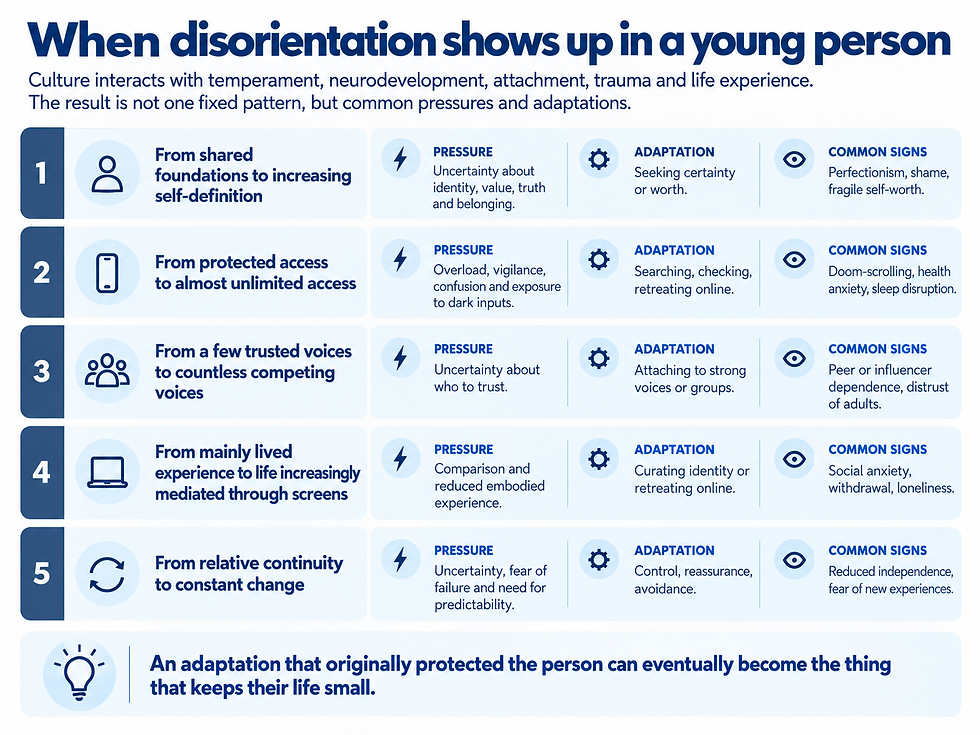
FIVE MAJOR CULTURAL SHIFTS
The five shifts below are Progeny's synthesis of the world forming Gen Z and Gen Alpha.

Consider the generation but understand the individual. |
1. From shared foundations to increasing self-definition
Every culture offers some framework for answering foundational questions: What is true? Who am I? What makes me valuable? Who can I trust? What is good? What is life for?
As mentioned above, previous generations in western culture were generally more likely to inherit established answers through family, faith, community and shared social expectations. Gen Z and Gen Alpha, however, are increasingly expected to discover or construct identity, morality, relationships and meaning for themselves. Yet self-definition never happens alone as our need for acceptance is fundamental. When group rejection threatens attachment then we nearly always compromise our authentic self to fit in. Young people may adjust language, appearance, beliefs or identity to remain connected to a peer or online group. The self can therefore feel both self-created and socially policed.[6][7][25]
Appearance, achievement, popularity and lifestyle have also become unusually visible and measurable. Comparing other people's edited lives with our own ordinary lives can make worth feel conditional: I am acceptable if I look right, achieve enough, belong or receive approval. Online social comparison is associated with body-image concerns and eating-disorder symptoms.[13]
A further cultural shift for young generations is that psychological and diagnostic language is now part of self-understanding. Terms such as anxiety, trauma, ADHD, autism, attachment and neurodivergence can reduce shame and bring clarity, however:
We should hold these things lightly: diagnostic language that gives understanding to something I experience can quickly become ‘this defines who I am and what I can do’.
Faith and spirituality also sit within this search for orientation. Gen Z and Gen Alpha encounter secular worldviews, therapeutic individualism, political and cultural ideologies, Christianity, other religions and personalised spirituality. From a Christian perspective, God is not one source of identity among many, but the ultimate source of life, truth, goodness and hope. Spiritual wellbeing can be protective, while negative religious coping can accompany poorer outcomes.[15] Healthy Christian formation should deepen truth, love, freedom, responsibility, relationship and hope rather than fear or manipulation.
THE SHEPHERD'S HEART Identity is received before it is performed. The good Shepherd knows and calls by name, offers belonging before achievement, and provides a trustworthy horizon for truth and value. His heart is not to leave the young person alone to invent a self, but to help them become secure enough to grow into who they are. |
2. From protected access to almost unlimited access
Young people have always encountered difficult ideas, sexuality, violence and competing beliefs. What has changed is access.
A young person can now privately encounter almost any form of material, immediately and repeatedly. Alongside learning and creativity sit pornography, sexualised imagery, graphic horror and cruelty, self-harm and suicide content, eating-disorder material, misogyny and hate, ideological extremes, diagnostic content, spiritual practices, and opportunities for grooming, coercion and exploitation.[24]
In this sense, Gen Z and Gen Alpha are an “experimented-on generation”. Persuasive digital environments were adopted at scale during childhood before their developmental effects were fully understood or protections caught up. Personalised systems also shape what appears next, so exposure is not always chosen.[2][3][24]
Bodies, sexuality and intimacy are important examples. Sexualised content and pornography can arrive before mature frameworks for embodiment, mutuality and intimacy; cultural ideals and comparison can also interact with vulnerability around body image and eating.[10][12][13]
The issue is not simply whether access is good or harmful, but what a developing person encounters, at what stage, with what protection and with what wise human guidance. Expanded access without proportionate protection is not neutral.
THE SHEPHERD'S HEART Protection is not control. A good shepherd watches, sets boundaries and recognises danger while allowing freedom appropriate to maturity. In a culture of near-unlimited access, the Shepherd's heart points to loving protection, wise gatekeeping and adults willing to stand between young people and exploitation or overwhelm. |
3. From a few trusted voices to countless competing voices
Parents, teachers, mentors and church leaders now compete with peers, creators, online communities, therapeutic voices, ideological groups, algorithms and AI for credibility.
A young person's most influential voice may therefore be someone their parents have never met - or something non-human. AI can support learning and creativity, but it can also become adviser, reassurance source or companion. UNICEF warns that children are increasingly turning to conversational AI for advice, support and relationship-like interaction.[4]
Development remains profoundly relational. Feeling known and having trusted adults, alongside care, challenge, support and growing agency, are associated with stronger belonging and resilience.[5][6][7]
A key paradox: those most in need of safe, regulating and truth-telling relationships may become increasingly disconnected from the very people through whom healing and development could occur.
Authority matters because trustworthy relationships help young people test ideas, regulate distress, gain perspective, face challenge and gradually navigate life for themselves.
THE SHEPHERD'S HEART Sheep learn the shepherd's voice. Young people need a small number of embodied, trustworthy voices whose authority grows from relationship, consistency and truth. The aim is not to silence every other voice, but to help them recognise which voices lead towards safety, reality, responsibility, love and life. |
4. From mainly lived experience to life increasingly mediated through screens
Digital life is no longer somewhere young people occasionally go; it is part of the environment in which they grow. For Gen Z and Gen Alpha, friendship, comparison, learning, sexuality and belonging increasingly span both physical and digital worlds.
Comparison follows the young person home; identity can be displayed publicly; belonging can be sought in communities whose members never meet; and mental health, spirituality and politics can be explored through personalised feeds. Two young people in one family can therefore inhabit very different worlds of influence.
Jonathan Haidt's The Anxious Generation has brought wide attention to the shift from a more play-based to a more phone-based childhood and argues that this carries developmental costs.[29] The wider evidence is more cautious: effects vary, but social comparison, sleep disruption, feedback sensitivity and particular content can matter for vulnerable young people.[2][3]
Online contact can maintain connection, but it is not equivalent to embodied relationship. Human beings are attachment-seeking: if secure connection is thin, the drive to belong does not disappear; it may become invested in peers, influencers, online groups, platforms or ideologies, even when those attachments are unhealthy.[25] Screens can carry words and care, but not the full embodied reciprocity through which people co-regulate and learn trust. Digital refuge may reduce distress yet refuge is not restoration.
The concern is not simply “screen time”, it is what the screen amplifies, reshapes or replaces.
When mediated life increasingly replaces face-to-face relationships, physical activity, challenge, responsibility and ordinary participation, what first reduced distress can begin to reinforce restriction.
THE SHEPHERD'S HEART The shepherd is present, embodied and responsive. Young people need real faces, shared space, ordinary life, movement, play, service and dependable relationships in which nervous systems can settle together. Digital contact may supplement relationship, but the Shepherd's heart draws people back towards embodied presence, belonging and participation. |
5. From relative continuity to constant change
Every historical period changes, but Gen Z and Gen Alpha are developing amid rapid shifts in technology, communication, work, relationships, identity, social expectations and AI. The cultural map can change while the young person is still learning to read it.
COVID intensified disruption to education, friendships, transitions and independence. Bereavement, family breakdown, bullying, trauma, school change, housing and employment conditions can further interrupt developmental momentum; not every delay is pathology.
Healthy development requires both safety and challenge: chances to try, fail, solve problems, take manageable risks, recover and become useful. British research documents reduced independent mobility and outdoor play across generations.[20]
Protection becomes costly when it repeatedly communicates “you cannot cope”. Healthy relationships combine care with challenge, support with responsibility and respect with growing agency.[5]
In a rapidly changing world, reassurance, predictability and avoidance can become attractive. The key question is whether disruption or protection has become stuckness - whether confidence, participation and developmental momentum have restarted.
THE SHEPHERD'S HEART The Shepherd does not remove every valley; he accompanies people through it. Stable presence, predictable rhythms, wise challenge and confidence borrowed from trusted adults help young people tolerate uncertainty and keep moving. The Shepherd's heart offers a secure base from which courage, agency and hope can grow. |
The Convergence: Disorientation
None of these shifts is wholly negative. Freedom can liberate; access can educate; digital environments can maintain contact; psychological language can reduce shame; technology can extend capability. The concern is what happens when all of these cultural shifts converge and create a perfect storm?
The young person is not necessarily weaker or more fragile. The navigation task itself has become more complicated.
Disorientation is a cultural and developmental outcome, not a diagnosis or complete explanation for anxiety or mental illness. Temperament, neurodevelopment, attachment, trauma, biology, family circumstances, poverty and loss remain essential. However, when orientation becomes difficult, anxiety rises and uncertainty about identity, trust, belonging or the future may drive attempts to regain safety, certainty, belonging or control by other means.[23]
Anxiety flourishes where orientation is difficult.
THE REJECTED SHEPHERD Without the shepherd, the young person is being asked to navigate dangerously wild places without the protection of the shepherd’s voice and the shepherds’ fold. This births the need for ‘adaptive survival’ where adaptations can be understood as attempts to recreate orientation - finding a group, identity, diagnosis, platform, ideology, psychological defence mechanism or a pattern of control that offers a surrogate sense of safety and belonging. |
Where these adaptations become restrictions
Attempts to regain safety, certainty, belonging or control may reduce distress in the short term, however these surrogate methods often erode capacity for social engagement, degrade self-worth and sap energy.
Pressure can prompt strategies that restore safety, certainty or belonging. The key question is what happens when these strategies become repeated and begin to organise life. What lowers distress today may reduce flexibility, confidence or participation tomorrow.

The above image shows a possible trajectory of increased disorientation. Restriction can move from mild disruption to loss of education, relationships, independence and participation. EBSA is one example of this negative slide. Disorientation can increase absence, while sustained absence can then make re-entry harder thus deepening the felt sense of isolation.[17][18] Severe withdrawal may resemble hikikomori, now documented in UK young adults.[19]

Regulate, Relate, Reason: Restorative responses towards reorientation and SHALOM
What healing therefore needs to do
If culture is part of formation, healing cannot be symptom control alone. Where disorientation is present, restorative work must help the young person become more regulated, relationally secure and oriented.
Bruce Perry's Regulate, Relate, Reason sequence offers a useful developmental framework.[27] A dysregulated young person is less available for reflection and problem-solving, so we begin with felt safety and regulation, build connection through attuned relationship, and then invite reflection, responsibility and wise choice. The adult's own regulated presence matters: we cannot reliably co-regulate from panic, frustration or threat.
In practice, this means strengthening identity and value; agency over attention and technology; discernment about influence; trustworthy relationships; embodied participation; tolerance of uncertainty; and confidence through manageable challenge. The aim is not to recreate the world adults grew up in, but to help young people become more regulated, connected, capable, discerning, purposeful and whole in the world they inhabit.
THE SHEPHERD OF SHALOM For Christian readers, the shepherd image gives Regulate, Relate, Reason a deeper theological resonance. The Shepherd draws near, protects and knows before he leads; his voice can orient because it is encountered within relationship. Presence precedes instruction, relationship makes direction receivable, and safe boundaries create freedom rather than fear. Reorientation is therefore not simply better coping, but movement towards trustworthy relationship and, ultimately, towards God as the source of peace, identity, belonging and direction - SHALOM: wholeness in relationship with God, self, others and the world. |
A word of wisdom across generations and cultures
Those helping a young person may differ from them in age, country of origin, language, faith, social assumptions or ways of expressing distress. Human needs for safety, attachment, value, meaning and control are remarkably stable, but cultures and generations can express and protect those needs differently. The same underlying distress may appear as bodily symptoms in one context, over-control in another, or withdrawal and online identity in another.[8][9]
This is where helpers can misread what they see. An unfamiliar adaptation may look like weakness, defiance or indulgence; advice that made sense in another generation or culture may feel dismissive or unsafe. Before correcting the behaviour, ask what it is doing for the person: What does it protect? What attachment or belonging is at stake? What would make change feel safe enough not to feel like abandonment?
Across these differences there is a meeting point for healing: REGULATE through calm, predictable safety; RELATE through unconditional love, genuine curiosity and holding the young person in high regard; then REASON together when enough trust exists for reflection and choice. This is both psychologically coherent and deeply consistent with a biblical shepherding posture - know the person, stay near, protect dignity, guide patiently and speak truth in love.
Thanks for reading. Progeny.
References and evidence base
Numbered citations in the text correspond to the sources below. The list also includes selected wider sources that inform the paper's conceptual framing.
No. | Source |
1 | World Health Organization (2025). Mental health of adolescents. https://www.who.int/news-room/fact-sheets/detail/adolescent-mental-health |
2 | Orben, A., Meier, A., Dalgleish, T. & Blakemore, S-J. (2024). Mechanisms linking social media use to adolescent mental health vulnerability. Nature Reviews Psychology, 3, 407-423. https://doi.org/10.1038/s44159-024-00307-y |
3 | American Psychological Association (2023). Health advisory on social media use in adolescence. https://www.apa.org/topics/social-media-internet/health-advisory-adolescent-social-media-use |
4 | UNICEF (2026). When AI becomes a friend: Child rights risks, harms, and regulatory responses to AI chatbots and companions. https://www.unicef.org/documents/when-ai-becomes-friend-child-rights-risks |
5 | Search Institute. Developmental Relationships Framework: express care, challenge growth, provide support, share power and expand possibilities. https://searchinstitute.org/developmental-relationships |
6 | Springtide Research Institute. Belonging: Reconnecting America’s Loneliest Generation. https://springtideresearch.org/research/belonging |
7 | Fuller Youth Institute (2026). Gen Alpha research: identity, belonging, purpose, faith and trusted adults. https://fulleryouthinstitute.org/gen-alpha |
8 | Ryder, A.G., Yang, J., Zhu, X. et al. (2008). The cultural shaping of depression: somatic symptoms in China, psychological symptoms in North America? Journal of Abnormal Psychology, 117(2), 300-313. https://doi.org/10.1037/0021-843X.117.2.300 |
9 | The integration of idioms of distress into mental health assessments and interventions: a systematic review (2019). PubMed PMID: 31143467. https://pubmed.ncbi.nlm.nih.gov/31143467/ |
10 | Qian, J., Wu, Y., Liu, F. et al. (2021). An update on the prevalence of eating disorders in the general population: a systematic review and meta-analysis. Eating and Weight Disorders. https://doi.org/10.1007/s40519-021-01162-z |
11 | Pike, K.M. & Dunne, P.E. (2015). The rise of eating disorders in Asia: a review. Journal of Eating Disorders, 3, 33. https://doi.org/10.1186/s40337-015-0070-2 |
12 | Gerbasi, M.E., Richards, L.K., Thomas, J.J. et al. (2014). Globalization and eating disorder risk: peer influence, perceived social norms, and adolescent disordered eating in Fiji. International Journal of Eating Disorders, 47(7), 727-737. https://doi.org/10.1002/eat.22349 |
13 | Bonfanti, R.C., Melchiori, F., Teti, A. et al. (2025). The association between social comparison in social media, body image concerns and eating disorder symptoms: a systematic review and meta-analysis. Body Image, 52, 101841. https://doi.org/10.1016/j.bodyim.2024.101841 |
14 | Sex Differences in the Global Prevalence of Nonsuicidal Self-Injury in Adolescents: A Meta-Analysis (2024). JAMA Network Open. PubMed PMID: 38874927. https://pubmed.ncbi.nlm.nih.gov/38874927/ |
15 | Aggarwal, S., Wright, J., Morgan, A. et al. (2023). Religiosity and spirituality in the prevention and management of depression and anxiety in young people: a systematic review and meta-analysis. BMC Psychiatry, 23, 729. https://doi.org/10.1186/s12888-023-05091-2 |
16 | Boreham, I.D. & Schutte, N.S. (2023). The relationship between purpose in life and depression and anxiety: a meta-analysis. Journal of Clinical Psychology, 79(12), 2736-2767. https://doi.org/10.1002/jclp.23576 |
17 | Office for National Statistics (2025). Child mental ill health and absence from school, England: 2021 to 2022. https://www.ons.gov.uk/peoplepopulationandcommunity/healthandsocialcare/childhealth/articles/childmentalillhealthandabsencefromschoolengland/latest |
18 | Department for Education (2025). Relationship between mental ill health and absence in students aged 13 to 16. https://www.gov.uk/government/publications/relationship-between-mental-ill-health-and-absence-in-students-aged-13-to-16 |
19 | Hassan, I., Chumun, K.K., Elkholy, H. & Nagai, Y. (2026). Social withdrawal among university students in the UK: the emerging hikikomori phenomena. British Journal of Psychiatry. https://doi.org/10.1192/bjp.2026.10688 |
20 | Dodd, H.F., FitzGibbon, L., Watson, B.E. & Nesbit, R.J. (2021). Children’s Play and Independent Mobility in 2020: Results from the British Children’s Play Survey. International Journal of Environmental Research and Public Health, 18(8), 4334. https://doi.org/10.3390/ijerph18084334 |
21 | Springtide Research Institute (2025). Four dimensions of young people’s spiritual and religious lives. https://springtideresearch.org/post/religion-and-spirituality/four-dimensions-of-young-peoples-spiritual-and-religious-lives |
22 | Youthscape. No Questions Asked / We Do God research on young people, faith, spiritual curiosity and practice. https://www.youthscape.co.uk/research/published-research/ |
23 | Osmanağaoğlu, N., Creswell, C. & Dodd, H.F. (2018). Intolerance of uncertainty, anxiety and worry in children and adolescents: A meta-analysis. Journal of Affective Disorders, 225, 80-90. https://doi.org/10.1016/j.jad.2017.07.035 |
24 | Ofcom (2025). Protection of children duties under the Online Safety Act: guidance on content harmful to children and risks including pornography, violent content, self-harm, grooming and recommender systems. https://www.ofcom.org.uk/online-safety/protecting-children/ |
25 | Baumeister, R.F. & Leary, M.R. (1995). The need to belong: Desire for interpersonal attachments as a fundamental human motivation. Psychological Bulletin, 117(3), 497-529. https://doi.org/10.1037/0033-2909.117.3.497 |
26 | Mesman, J., van IJzendoorn, M.H. & Bakermans-Kranenburg, M.J. (2009). The many faces of the Still-Face Paradigm: A review and meta-analysis. Developmental Review, 29(2), 120-162. https://doi.org/10.1016/j.dr.2009.02.001 |
27 | Perry, B.D. & Ablon, J.S. (2019). CPS as a Neurodevelopmentally Sensitive and Trauma-Informed Approach. In Collaborative Problem Solving: An Evidence-Based Approach to Implementation and Practice, pp. 15-31. Springer. https://doi.org/10.1007/978-3-030-12630-8_2 |
28 | McCrindle, M., Fell, A. & Buckerfield, S. (2021). Generation Alpha: Understanding Our Children and Helping Them Thrive. Hachette Australia. |
29 | Haidt, J. (2024). The Anxious Generation: How the Great Rewiring of Childhood Is Causing an Epidemic of Mental Illness. Penguin Press. |
Biblical foundations
Genesis 1-3; Psalm 23; Isaiah 40:11; Jeremiah 2:13; Matthew 6:19-34; Luke 15:3-7; John 10:1-18; John 15:1-11; Romans 1:21-25; Romans 12:1-2; 1 Corinthians 12:12-27; and Hebrews 10:24-25.
Progeny | October 2026


Comments